CONTINENTAL F227D-600 Pistons Connecting Rods Miller Big F163A-408
fits model: F163, F227d, 600.
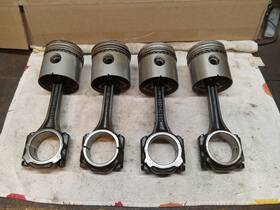
( Brand: Continental ), ( Manufacturer Part Number: F227D-600 ), ( Type: Connecting Rod Set ), ( Oe/oem Part Number: F163a-408 ), ( Items Included: Rods And Pistons )
Review CONTINENTAL Pistons And Connecting Rods Miller Big 40 fits F163 F227D 600
The **Continental F227D-600 F163 Pistons and Connecting Rods (F227D-600, F163A-408 "Miller Big 40")** represent a pinnacle of aviation piston engine design, meticulously engineered for high-performance, long-endurance flight in the legendary **Continental O-470 "Big 40"** series. These components are a critical part of the **Miller Cycle** variant of the F227D, a modified version of the classic O-470-A that incorporates advanced Miller timing to enhance thermal efficiency, power output, and reliability particularly in high-altitude and sustained-cruise applications. The **F227D-600** designation signifies a high-compression, fuel-injected iteration of the engine, optimized for superior performance with aviation gasoline (100LL or higher octane blends), while the **F163A-408** pistons are specifically forged from high-strength **408 aluminum alloy**, reinforced with **chromium-molybdenum steel inserts** for durability and resistance to thermal expansion. The **connecting rods**, crafted from **chromoly steel (4340 or equivalent)**, are precision-machined with **full-floating pins** and **hardened big-end bearings**, ensuring minimal wear and maximum load-bearing capacity under the extreme stresses of high-RPM operation. The **Miller Cycle modifications** including advanced valve timing and a unique piston crown design allow the engine to achieve **higher thermal efficiency** by optimizing the combustion process, reducing fuel consumption, and extending operational range without sacrificing power. These components are designed for **high-altitude performance**, where the Miller Cycle s ability to maintain efficiency in lean-mixture conditions provides a significant advantage over conventional engines. Whether installed in a **high-wing bush plane, a modified military trainer, or a custom-built endurance aircraft**, the **F227D-600 F163 pistons and connecting rods** deliver a blend of **heritage reliability and cutting-edge aerothermal engineering**, making them a sought-after upgrade for pilots and engineers seeking to push the boundaries of piston-engine aviation. Built to exacting **Continental Aerospace specifications**, these parts are fully compatible with aftermarket support systems, including **high-performance fuel injection, turbocharging, and supercharging setups**, ensuring they can be tailored to meet the demands of both stock and heavily modified aircraft. The **F227D-600** is particularly renowned for its **smooth operation, low vibration, and exceptional durability**, making it a favorite among pilots who demand both performance and longevity from their powerplants.
### **Pros and Cons of Buying Continental F227D-600 (F163) Pistons, Connecting Rods, F227D-600 (F163A-408) Miller Big 40 Engine Components**
#### **Overview**
The Continental F227D-600 (also referred to as the F163 or F163A-408 Miller Big 40) is a high-performance, turbocharged aircraft engine designed for general aviation aircraft like the Cirrus SR22/22T, Cirrus Vision SF50, and other models. It features Miller cycle combustion (variable valve timing) for improved efficiency and power. When considering aftermarket pistons, rods, or other critical components, there are key advantages and drawbacks to weigh.
---
### **Pros**
1. **Enhanced Performance and Power**
- Aftermarket pistons (e.g., from manufacturers like **Aero Engine Components, JE Aero, or Precision Aero**) are often forged from high-strength materials (e.g., 4340 steel or titanium) to withstand higher RPMs, boost pressures, and thermal loads. This can improve horsepower and torque, especially when paired with a tuned turbocharger or Miller cycle modifications.
- The Miller cycle (F163A-408) allows for better fuel efficiency and power output by optimizing valve timing, reducing pumping losses, and improving combustion efficiency.
2. **Increased Durability and Longevity**
- Forged pistons and connecting rods are stronger than cast alternatives, reducing the risk of failure under high-stress conditions (e.g., aggressive climbs, high boost, or extended overhauls).
- Some aftermarket rods (e.g., **Precision Aero s F227D rods**) are designed with improved fatigue resistance, reducing the likelihood of catastrophic failure.
3. **Compatibility with Modifications**
- The F227D-600 is already a modified engine (from the base F227D), and aftermarket parts can further support upgrades like:- **Turbocharger swaps** (e.g., Garrett GTX 3.5 or Honeywell TPE331 derivatives) for more power.
- **Miller cycle tuning** (e.g., adjusting valve timing via the F163A-408 s electronic control) to optimize performance.
- **Fuel system upgrades** (e.g., fuel injectors, fuel pumps) to handle higher flow rates.
- These components can be retrofitted into existing engines without major structural changes.
4. **Weight Reduction (in some cases)**
- Some aftermarket pistons (e.g., titanium) are lighter than traditional aluminum or steel, which can slightly reduce engine inertia and improve throttle response.
5. **Support for Extended Overhaul Intervals**
- High-quality aftermarket parts may allow for longer time-between-overhauls (TBO) if properly maintained, reducing downtime and costs in the long run.
6. **Customization and Tuning Potential**
- Engines like the F163A-408 benefit from electronic control of the Miller cycle, allowing for dynamic tuning. Aftermarket components can be paired with ECU upgrades (e.g., **Garmin G3X with engine monitoring**) for optimized performance.
7. **Wider Availability of Support**
- The F227D-600 is a popular engine, so aftermarket parts, manuals, and technical support are more accessible than for rare or discontinued models.
---
### **Cons**
1. **High Upfront Cost**
- Aftermarket pistons and rods (especially forged or titanium) are significantly more expensive than OEM parts. For example:- A set of **Precision Aero F227D pistons** may cost **$3,000 $5,000 **, while OEM replacements could be **$1,500 $2,500**.
- Custom-machined rods or high-end components add to the expense.
- The **F163A-408 Miller conversion** itself is a substantial investment (often **$20,000 $40,000 **), assuming it s not already installed.
2. **Potential for Voiding Warranties**
- Modifying an engine with aftermarket parts (especially non-FAA-approved components) may void the manufacturer s warranty. Continental s warranty typically covers OEM parts and factory modifications only.
- Some insurance providers may also restrict coverage for modified engines, increasing premiums or requiring additional endorsements.
3. **Complex Installation and Tuning**
- Installing aftermarket pistons or rods often requires:- **Engine teardown and inspection** to ensure compatibility.
- **Dynamic balancing** of the crankshaft and rods to prevent vibration issues.
- **ECU or fuel system recalibration** if performance is being altered.
- This work should be done by a **licensed aviation mechanic (IA)** with experience in Continental engines, adding labor costs.
4. **Risk of Improper Fit or Failure**
- Not all aftermarket parts are FAA-certified for the F227D-600. Some manufacturers may offer "performance" parts that are not approved for flight, which could lead to:
- **Reduced reliability** if the parts are not stress-tested for aviation use.
- **Potential for catastrophic failure** if the components are not properly matched to the engine s operating parameters.
- Always verify that parts meet **FAA Part 33 (airworthiness) standards** or are installed under a **Special Condition** (if applicable).
5. **Maintenance and Inspection Challenges**
- Aftermarket components may require **different inspection intervals** or **specialized testing** (e.g., magnetic particle inspection for cracks in forged rods).
- Some parts (e.g., titanium pistons) may have different thermal expansion properties, requiring adjustments to oil viscosity or cooling systems.
6. **Limited Long-Term Data**
- While the F227D-600 and Miller cycle are well-documented, aftermarket parts may not have the same **field service history** as OEM components. This lack of long-term data can make it harder to assess reliability.
- Some pilots report issues with **valve float, turbo lag, or fuel system limitations** when pushing the engine beyond stock parameters.
7. **Potential for Reduced Reliability if Misapplied**
- The F227D-600 is already a high-performance engine. Aggressive modifications (e.g., excessive boost, improper fueling) can lead to:- **Premature wear** on cylinders, rods, or bearings.
- **Thermal stress** causing warping or cracking.
- **Fuel system starvation** if injectors or pumps are not upgraded.
- The Miller cycle (F163A-408) requires precise tuning; poor calibration can reduce efficiency or cause rough operation.
8. **Resale Value Impact**
- Modified engines (especially with aftermarket parts) may have **lower resale value** than stock or factory-upgraded units. Buyers often prefer engines with minimal or no modifications for simplicity and warranty coverage.
---
### **Key Considerations Before Purchasing**
1. **Purpose of Modification**
- Are you looking for **marginal power gains** or **significant performance increases**?
- If the goal is **better fuel efficiency**, the Miller cycle (F163A-408) may be more valuable than just pistons/rods.
- If the goal is **raw power**, ensure the rest of the engine (turbo, fuel system, ignition) can support it.
2. **FAA Compliance**
- Confirm that any aftermarket parts are **FAA-approved** or installed under a **Supplement Type Certificate (STC)**.
- Consult with a **Continental-authorized repair station** or **IA** before installation.
3. **Maintenance and Support**
- Ensure you have access to **qualified mechanics** familiar with the F227D-600 and aftermarket parts.
- Consider **extended warranty options** if purchasing from a reputable supplier.
4. **Cost-Benefit Analysis**
- Calculate whether the **performance gains** justify the **cost and complexity** of aftermarket parts.
- Example: A **$5,000 piston upgrade** may only yield **5 10 HP more** is that worth the investment for your flying needs?
5. **Alternative Solutions**
- Instead of full engine modifications, consider:- **Factory upgrades** (e.g., Continental s **F227D-600T** with stock turbo).
- **Fuel system upgrades** (e.g., **Garmin G3X with fuel flow monitoring**).
- **Lightweight propellers** (e.g., **Hartzell or McCauley**) for better efficiency.
---
### **Conclusion and Recommendation**
#### **Who Should Buy Aftermarket Pistons/Rods for the F227D-600?**
- **Pilots who prioritize performance and are willing to invest in reliability** (e.g., aerobatic pilots, cross-country flyers pushing limits).
- **Owners of Miller cycle (F163A-408) engines** who want to optimize power and efficiency.
- **Those with access to professional installation and tuning** (DIY is not recommended for critical components).
Details:
No spun bearings. Threads are all good. May require rebuilding to some degree. Pistons show signs of wear.
Comes exactly as shown in pictures.
part #: f227d600 prices
- $32.00-$63.00
specifications pistonrinro:
- for models: F163, F227d, 600
- brand: Continental
- mpn: F227d-600
- type: Connecting Rod Set
- oe/oem part number: F163a-408
- items included: Rods And Pistons
seller pistonrinro:
- city: Unity, Maine
- # reviews: 272
- rating: 100.0%
returns pistonrinro:
- paid by: Seller
- policy: Returns Accepted
- time: 30 Days
general pistonrinro:
- Car Truck Parts Accessories > Engines Engine Parts > Connecting Rods Parts
- condition: Used
payments pistonrinro:
- credit card: Mastercard
- wallet: Paypal
- other
offer pistonrinro:
- sold: 0
- best offers: True
- options: Ship-to-home
- quantity: 1
- started: April 5, 2026
- availability: In Stock
shipping pistonrinro:
- service: USPS Ground Advantage
- cost: $14.58
- class: Standard
- type: Calculated
- carrier: USPS
- transit: 5-11 Days
Continental F227D-600 Is Similar To:
- 2103 040 Kaiser Frazer Continental Engine Nors Silvolite Pistons (27.6% similar) 118,140 hp 7,3 COMP,2 bbl carb replaces orig assay mfg cast ,15 16 bore I6-226 comp as you can see these were still factory til I opened them for the pictures book states. These are not shinny and pretty but will perform the task they were meant. 040 pistons with pins. 6 new kilovolt kaiser Frazier ...(November 3rd, 2018)
- N-na-v4 Continental 1914-1926 Pistons To Fit Models (41.7% similar) 03125 length compression height no pins. Continental pistons, to fit model's n Na V4, set of 4, diameter 3/3...(March 6th, 2016)
- Y400c-218 Y400g-219 Continental Y91 Y112 Engine Connecting Rod Bearings (44% similar) They are new old stock from a military surplus engine rebuild kit, still in the factory applied coastline. This is 1 set of 4, standard size connecting rod bearings to fit the Continental Y91 Y112 engines. Buyer pays shipping. Two to fit rods two to fit rods 2 only...(October 19th, 2015)
- Cr162 Continental Engine Connecting Rod Casting (48.9% similar) Continental CR162 casting W5D 0THESE look to be re rabbited and have nice clean bearing surface with rust on the iron. This sale is for one connecting rod to fit older 4 cylinder Continental engines: h1 ,H2 ,H8 ,H9 ,P2A ,P-11 ,P-11A ,P20,W5...(March 7th, 2018)
- R758 Ford V12 Lincoln Continental Zephyr Vintage Mercury Connecting Rods (40% similar) This sale includes a set of 12 total rods sold as used because of time in storage 30 years comes with 2 original boxes the other boxes were ruined, pioneer part number R758 casting forging numbers are 26H6205, 86H6205, HB6205 nos rebuilt con rods for a V12 Lincoln Continental zephyr...(December 24th, 2015)
- L2309f F-124 Trw Nos Continental Pistons Forged Standard Size (38.9% similar) Nos Continental standard size trow pistons 4 forged L2309F F-124 please view the photos and ask questions if needed. As you know vintage nos item that have been in private hands will show some shelf ware. Our listing only indicates what information research has found but in no way guarantees that it...(June 10th, 2019)
- 24b F6209 Pistons Pf209 F209 Continental 020 Cylinder 6 Nos (31.1% similar) New old stock badger pistons us. A made part number P1903...(May 1st, 2015)
- Sa629340 Superior Continental Connecting Rod Bolts Quantity Of Free Ship (36.3% similar) ...(November 8th, 2018)
- Kaiser Cr1228 cr1229 Frazer willys Jeep Truck continental f226 Connecting Rods Set Of 6 Recon (38.5% similar) One set of connecting rods for the Continental F226 engine used in Willy's jeep and several industrial applications...(February 2nd, 2024)
- Wis-con Total Power Da51cs1 Wisconsin Continental Connecting Rod (33.8% similar) Part #: Wis-con total power DA51CS1 for sale...(July 9th, 2025)
- Wis-con Total Power Da49bs1 Wisconsin Continental Connecting Rod (33.8% similar) Part #: Wis-con total power DA49BS1 for sale...(July 9th, 2025)