TOYOTA VWM6JE Connecting Rods MR2
fits model: 4age, Corolla. make: Toyota. year: 1984-89.
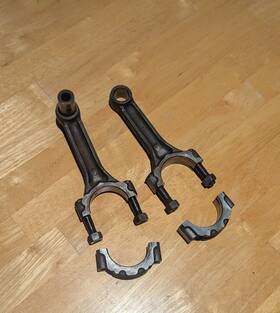
( Manufacturer Part Number: VWM6JE ), ( Big End Width: 21.8mm ), ( Rod Length: 122mm ), ( Fitment Type: Performance/custom ), ( Hp: Around 600-800hp ), ( Pin Type: Bronzed Bushing Floating Pin ), ( Quantity: Set Of 4 Pieces ), ( Material: Steel ), ( Bundle Listing: Yes ), ( California Prop 65 Warning: California Prop 65 Warning ), ( Type: Connecting Rod ), ( Notice: This Is Aftermarket Replcement Part ), ( Manufacturer Warranty: 2 Years ), ( Note: No Instruction Included ), ( Weight Tolerance: Balanced To / 1 Gram In Set ), ( Surface Finish: Brand New ), ( Big End Diameter: 45mm ), ( Small End Diameter: 20mm ), ( Country Of Origin: China )
Review TOYOTA Mr2 1984 89 Pair Of Connecting Rods Only fits COROLLA 4AGE 1984-89
The **Toyota VWM6JE 4A-GE engine** found in the iconic **Corolla (E80/E90/E100) and MR2 (W20)** models from **1984 to 1989** represents a legendary piece of automotive engineering, celebrated for its lightweight construction, high-revving spirit, and enduring performance. This **1.6-liter inline-four cylinder** powerplant, often referred to as the **"4A-GE,"** was Toyota s first production **DOHC (Double Overhead Camshaft)** engine, a bold departure from the traditional SOHC designs of the era. The **VWM6JE** variant, specifically, denotes a **four-valve-per-cylinder** configuration, which allowed for superior airflow, higher RPM potential, and a more aggressive exhaust note qualities that made it a favorite among tuners and enthusiasts. The engine s **aluminum block and head** construction not only reduced weight but also improved thermal efficiency, while the **piston-to-connecting rod assembly** plays a critical role in its reliability and performance. These **forged or high-quality cast connecting rods**, paired with **hypereutectic pistons**, were designed to withstand the extreme stresses of high-revving operation, often pushing beyond **8,000 RPM** in stock form and even higher when modified. The **4A-GE s** reputation for durability, combined with its natural affinity for forced induction (thanks to its robust internals), has cemented its place in tuning culture, making it a sought-after component for restorations, builds, and performance applications. Whether sourced for a **restomod Corolla** or a **street-legal MR2**, the **VWM6JE s** connecting rods and supporting components ensure a blend of vintage charm and modern performance, embodying the perfect marriage of Toyota s precision engineering and the driver s passion for speed.
### **Pros and Cons of Buying a 1984 1989 Toyota Corolla MR2 (VWM6JE) with a 4-Age Connecting Rod Issue**
#### **Pros**
1. **Classic Design and Driving Experience**
The MR2 is a mid-engine roadster with a unique, wedge-shaped silhouette that remains desirable among automotive enthusiasts. Its lightweight construction and rear-wheel-drive layout provide a sporty, engaging driving experience that is distinct from front-wheel-drive sedans like the Corolla.
2. **Reliability of Toyota s Base Platform**
The MR2 shares its engine (the 1.6L or 1.8L 4A-GE) and many mechanical components with the Corolla, which is known for durability. The 4A-GE engine, when properly maintained, can last well beyond 200,000 miles, especially in the 1.8L variant (introduced in 1986), which is more refined than the earlier 1.6L.
3. **Affordability and Availability of Parts**
As a discontinued model, the MR2 is relatively inexpensive to purchase, especially in its current condition. Parts are widely available, though some may require sourcing from specialty suppliers or Japanese importers. The aftermarket also offers aftermarket upgrades (e.g., suspension, brakes, exhaust) to improve performance and handling.
4. **Potential for Restoration or Modification**
The MR2 is a popular project car, and its simplicity (compared to modern vehicles) makes it manageable for DIY enthusiasts. Restoring one to original condition or modifying it for track use (e.g., lowering, engine swaps, or suspension upgrades) can be rewarding. The 4A-GE engine is also a favorite for swapping into other cars (e.g., MR2 Spyder, Supra, or even front-wheel-drive platforms).
5. **Nostalgia and Community**
The MR2 has a dedicated following, with clubs, forums, and events (e.g., MR2 meets, rallies) where owners can share knowledge and find support. This community can be invaluable for troubleshooting, finding rare parts, or simply enjoying the shared passion for the model.
6. **Fuel Efficiency**
The 4A-GE engine is relatively efficient for its time, achieving around 25 30 MPG in a stock MR2. While modern hybrids or electric cars are more efficient, the MR2 offers a fun, retro driving experience without excessive fuel consumption.
7. **Simplicity of Maintenance**
The MR2 s mechanical simplicity (compared to modern electronics-heavy vehicles) means that many repairs can be done with basic tools. The engine, transmission, and suspension are straightforward to work on, making it accessible for hobbyists.
---
#### **Cons**
1. **Connecting Rod Issue (4-Age Rods)**
The most critical drawback of the 1984 1989 MR2 is the **connecting rod problem** in the 4A-GE engine. Toyota used **four different rod designs** over the model s lifespan:
- **1984 1985 (1.6L 4A-GE):** Rods with a **flat surface** on the small end, prone to **seizing or cracking** due to poor lubrication or overheating.
- **1986 1989 (1.8L 4A-GE):** Rods with a **dished surface** (later versions), which are more robust but still require attention.
- **1989 (1.8L 4A-GE):** Rods with a **fully revised design**, addressing the earlier issues.
**Symptoms of rod failure:**- **Knocking or rattling** from the engine (especially under load or when cold).
- **Blue smoke** from the exhaust (indicating oil burning).
- **Compression loss** or **hard starting**.
- **Seized engine** (in extreme cases).
**Risks:**- A seized rod can **destroy the engine** if not caught early, leading to **expensive rebuilds or replacements** (a new 4A-GE engine can cost **$2,000 $4,000** depending on source).
- The **1984 1985 rods** are the most problematic; later models (1986 ) are less likely to fail but still require vigilance.
- **No warranty coverage** Toyota did not recall these engines, so buyers are on their own.
2. **Rust and Structural Corrosion**
Many early MR2s (especially those driven in wet climates) suffer from **rust in the floor pans, subframe, and suspension components**. This can weaken the chassis and lead to **expensive repairs** if not addressed. A thorough inspection of the **undercarriage, welds, and suspension mounts** is essential.
3. **Wear and Tear on Suspension and Steering**
The MR2 s suspension (MacPherson struts, sway bars, and ball joints) is **notoriously soft** compared to modern standards. Many examples have:- **Worn bushings** (control arm, sway bar).
- **Leaking struts** (common in older MR2s).
- **Steering rack issues** (play or fluid leaks).
- **Tire wear** (due to soft suspension and lack of modern traction).
Upgrading to **stiffer springs, sway bars, or coilovers** is often necessary for a comfortable and responsive ride.
4. **Transmission Problems**
The **4-speed manual transmission** (common in early MR2s) is generally reliable but can develop:- **Slippage** (especially in the 3rd or 4th gear).
- **Clutch wear** (requiring frequent replacements).
- **Synchronizer issues** (grinding gears).
The **automatic transmission** (available in later models) is more robust but still prone to **fluid leaks and solenoid failures**.
5. **Electrical and Interior Wear**
- **Faulty wiring harnesses** (common in older Toyotas).
- **Worn interior components** (seats, dashboard, door panels).
- **Rust in the battery tray** (leading to ground issues).
- **Non-working accessories** (power windows, seats, or stereo).
6. **Limited Modern Comfort and Safety**
- **No ABS or modern braking systems** (early MR2s have basic drum or disc brakes).
- **Poor visibility** (small windshield, limited rearview angles).
- **No modern safety features** (airbags, stability control).
- **Soft ride quality** (compared to modern suspensions).
7. **Fuel and Emissions Compliance**
- **Smog checks** may be required in some states (depending on age and modifications).
- **Modern fuel standards** mean some older MR2s may struggle with **ethanol blends** (though the 4A-GE handles it well).
- **Exhaust restrictions** in some areas (though the MR2 s simple exhaust system is easy to modify).
8. **Depreciation and Resale Value**
While the MR2 holds value among enthusiasts, its **general automotive market value is low**. A restored or well-maintained example may retain some appeal, but a project car with known issues will depreciate quickly.
---
### **Ending Conclusion**
Buying a **1984 1989 Toyota MR2 (VWM6JE) with a 4-age connecting rod issue** is a **high-risk, high-reward** proposition. The car offers a **unique driving experience, reliability in its core platform, and a strong enthusiast community**, but the **connecting rod problem is a major liability** that can turn a fun project into a financial nightmare if not properly addressed.
**If you proceed, you must:**- **Verify the rod type** (1984 1985 rods are the worst; 1986 are better).
- **Check for signs of rod wear** (knocking, oil consumption, compression test).
- **Budget for a full engine rebuild or replacement** if the rods are compromised.
- **Inspect for rust, suspension wear, and electrical issues** before purchasing.
- **Be prepared for maintenance** (clutch, struts, bushings, etc.).
**If you are not comfortable with mechanical work or cannot afford major repairs, this is not the right car for you.** However, if you **love the MR2 s design, enjoy working on cars, and are willing to invest time and money into a project**, it can be an incredibly rewarding experience.
---
### **Recommendation**
1. **If you want a reliable, low-maintenance classic:**- Consider a **later-model MR2 (1990 )** with the **revised 4A-GE rods** and **improved suspension**.
- Alternatively, look for a **well-documented, restored MR2** where the owner has already addressed the rod issue.
2. **If you want the original MR2 experience and are okay with risk:**- **Buy from a reputable seller** who provides **full maintenance records** (especially engine work).
- **Get a pre-purchase inspection** from a **4A-GE specialist** to check for rod wear.
- **Budget $3,000 $6,000 ** for repairs
Details:
I had them as spare parts for my cars, don't know the history behind but there is no visible damage. One of them has a pin that needs to get pressed out.
part #: vwm6je prices
- $70.00-$359.18
specifications pistonrinro:
- for models: 4age, Corolla
- for makes: Toyota
- for years: 1984-89
- mpn: Vwm6je
- big end width: 21.8mm
- rod length: 122mm
- fitment type: Performance/custom
- hp: Around 600-800hp
- pin type: Bronzed Bushing Floating Pin
- quantity: Set Of 4 Pieces
- material: Steel
- bundle listing: Yes
- california prop 65 warning: California Prop 65 Warning
- type: Connecting Rod
- notice: This Is Aftermarket Replcement Part
- manufacturer warranty: 2 Years
- note: No Instruction Included
- weight tolerance: Balanced To / 1 Gram In Set
- surface finish: Brand New
- big end diameter: 45mm
- small end diameter: 20mm
- country of origin: China
payments pistonrinro:
- credit card: Discover
- wallet: Google-pay
- other
shipping pistonrinro:
- type: Calculated
- transit: 4-10 Days
- service: USPS Ground Advantage
- cost: $9.35
- carrier: USPS
- class: Standard
offer pistonrinro:
- availability: In Stock
- quantity: 1
- sold: 0
- started: May 25, 2026
- best offers: True
- options: Ship-to-home
seller pistonrinro:
- rating: 100.0%
- # reviews: 335
- city: Sturgis, Mississippi
returns pistonrinro:
- policy: No Returns
general pistonrinro:
- condition: Used
- Car Truck Parts Accessories > Engines Engine Parts > Connecting Rods Parts
Toyota VWM6JE Is Similar To:
- 13101-22010 13101-24010 Art Toyota Corolla K 3k Standard Piston Set With Pins Rings (38.2% similar) Toyota corolla k and 3k standard piston set with wrist pins and rings. Made in japan by art. Used in the KE1, KE2, KE3, KE20 and KM10...(June 30th, 2016)
- Ry 2509 Repco Toyota Corolla Kc Engines Piston Set (35.3% similar) In perfect original condition inches plus 050MM. One new set of pistons with rings and wrist pins for a toyota corolla kc 3KC engine from 1967 thru. These are repack brand ry 2509 plus...(June 26th, 2018)
- 13101-16121-03 Toyota 4age Hi Comp 10.3 To 1 Pistons And Motor Bearings 1991 Corolla Gts (24.2% similar) Bearings all in great shape. Rings not included. Bought brand new in 2006 ' there was limit avail out of japan then. Qty of 4 size number 3 stock bore pistons 4AGE hi 10. If you special order these pistons from toyota out of japan they retail for somewhere around us. And I'm not sure you can get ...(October 21st, 2016)
- Maxpeedingrods Rgo24q Titanizing Racing 4340 Connecting Rods For Toyota Auris E180 Nr 8nr-fts 1.2t (33.5% similar) 7TH, . All big and small ends are finished with sunken honing machine, - precision alignment sleeves positively locate the rod cap, maintaining end bore size eliminating cap walk, 100% x-rated, sonic tested , multi-stage heat treated, shot preened to relieve stress, come bronzed bushing suitable for...(August 12th, 2023)
- Maxpeedingrods P1dv8l 4pcs Connecting Rods For Toyota Celica Gt-s Corolla T-sport 2zzge 2zz-ge 1.8l (31% similar) Best costumer service. It begins from the date purchased. V certification con rods, type: forged 4340 aircraft chrome Molly quality steel for racing, h-beam Conrad's quantity: 4 pieces a set, bolts:including genuine APR 2000 bolts, note: extra cost upgrading to L19 bolts size: 3/8 tolerance: ...(September 18th, 2023)
- Maxpeedingrods Osxb9u Steel H-beam Connecting Rods Arp Bolts For Toyota 20r 22r 22re 22ret 2.2 2.4l (31% similar) us Facebook account: . It secure the connecting rod and bearing to crankshaft. V product test and ISO 9001 certified, fastener yield psi. It effectively avoid reload scatter phenomenon. Advertised horsepower RATING:200HP/PIECE, top acceleration: 9000RPM, package size 28CM 21CM 10CM. We care about ...(October 14th, 2023)
- Maxpeedingrods H521xm 4340 Forged Connecting Rods Bolts For Toyota Corolla Celica Carina Fx Mr2 4a-fe (35.3% similar) Advertised horsepower RATING:200HP/PIECE, top acceleration: 9000RPM, package size 28CM 20CM 10CM. Always the correct part. Quick, simple. Manufacturer.guaranteed fitment. 4340 forged connecting rods bolts for toyota corolla Celia Carina Fox MR2 4A-FE. For toyota 4AFE 1.6L engine, corolla 1987 -2001...(October 20th, 2023)
- Maxpeedingrods Pn36e8 Connecting Rods For Toyota Corolla 4age Aa63 Ae86 At160 At171 Carina 1.6l 122mm (29.4% similar) It effectively avoid reload scatter phenomenon. It secure the connecting rod and bearing to crankshaft. A weak rod bolt in a racing engine means catastrophic disaster and will put your life at risk. Shot-preened finish to remove potential for stress risers, 6.HIGH precision CBC machined,precision ...(October 28th, 2023)
- Oe Quality 1320129685a0 Connecting Rods 4x Fits Toyota Corolla Matrix Camry 2.4l L4 Gas (34.6% similar) 13201-29685-C0 C0. Please compare carefully with photos or OE number before purchasing the part. 13201-29685-A0 A0. 13201-29685-B0 B0. Product view details. 13201-29685. With these parts you can replace your defective simply plug and play. Oem part number...(October 30th, 2023)
- Maxpeedingrods T2wp4e Forged H-beam Connecting Rods Arp Bolts For Toyota Tacoma Hilux 2rzfe 2.4l 135mm (36.3% similar) All big and small ends are finished with sunken honing machine, precision alignment sleeves positively locate the rod cap, maintaining end bore size eliminating cap walk, -100% x-rated, sonic tested , -multi-stage heat treated, shot preened to relieve stress, come bronzed bushing suitable for ...(November 1st, 2023)
- Maxpeedingrods N4mblv 4x Forged H-beam Connecting Rod Arp Bolt Set For Toyota 5efe Corolla Paseo 800hp (36.3% similar) It secure the connecting rod and bearing to crankshaft. We care about your engine as much you do. us Facebook account: . All big and small ends are finished with sunken honing machine, precision alignment sleeves positively locate the rod cap, maintaining end bore size eliminating cap walk, 100% x-...(November 11th, 2023)